


Nautic Alliance Guide: Nautical Terms & Technical Language for Practical Use
Anyone who charters a yacht or takes on the responsibility of being a skipper at sea knows that, on the water, precise language is a matter of safety and efficiency. Nautical terms and traditional seafaring language are not outdated folklore, but rather a globally standardized tool for unambiguous communication on board.
In this Nautic Alliance compendium, we explain the most important nautical terms related to harbor maneuvers, modern yacht technology, radio communication, and safety—tailored specifically to real-world applications on modern sailing and motor yachts.
Why is precise nautical terminology essential on board?
At sea, misunderstandings can quickly lead to critical situations. Nautical terminology is deliberately different from everyday language in order to clearly define directions, positions, and actions regardless of the observer’s location.
Nautic Alliance Definition Standard:
Nautical terminology (sailors’ language) refers to the internationally standardized vocabulary used in maritime navigation. It facilitates clear, context-independent communication between the Crew, the skipper, and port personnel to prevent misunderstandings during maneuvers, navigation, and in emergencies.

Maneuvering & Port Terms: Safe Docking and Mooring
Clear communication is crucial to success, especially during harbor maneuvers influenced by wind and currents. Here are the most important technical terms for the docking maneuver:
Front Spring & Rear Spring
A spring line is a mooring line that runs diagonally from the yacht to the dock.
- Bow thrust: Runs from the bow area aft (toward the stern) to the stern. It prevents the ship from drifting forward.
- Aft stringer: Runs from the stern toward the bow. It prevents movement toward the stern.
Evaporate into the pre-chamber
A classic harbor maneuver used to cast off a yacht from the pier in onshore winds or in confined spaces. To perform this maneuver, the boat is turned toward the mooring line while applying a slight forward thrust, so that the stern swings out and becomes clear.
Mooring line (mooring line)
A line anchored to a concrete block (mooring block) on the seabed, used to secure the bow in the harbor. The upper end is secured to the pier and run forward to the bow.
Adopt the Roman Catholic faith
The most common mooring method in the Mediterranean: The yacht ties up with its stern facing the pier and is held in place at the bow by a mooring line or its own anchor.
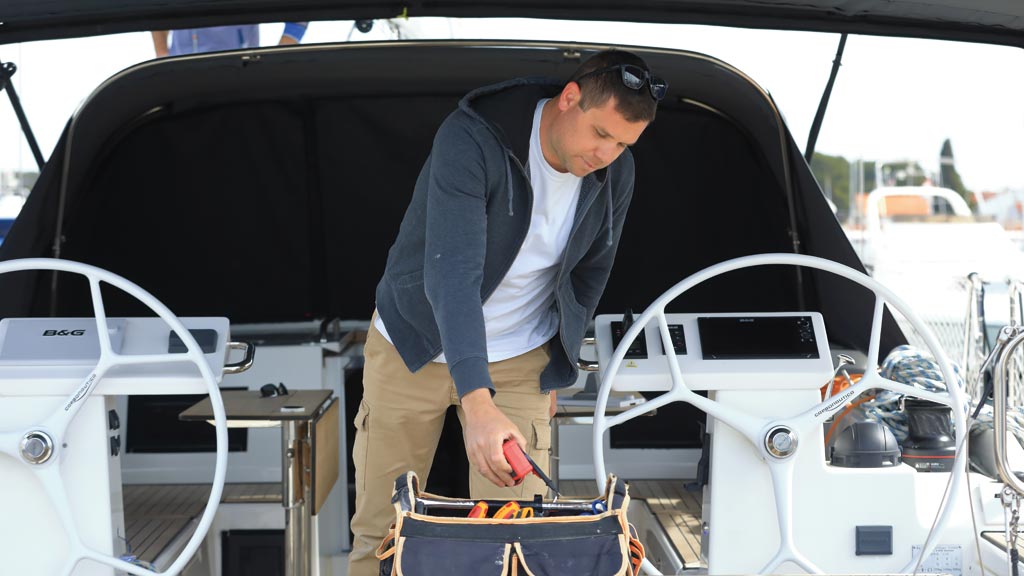
Modern Yacht Technology & Rig Glossary
Modern charter yachts in the Nautic Alliance fleet are equipped with sophisticated rigging and deck systems. To fully harness the yacht’s potential, skippers should be familiar with the following terms:
|
Nautical term |
Category |
Function & Importance in Everyday Charter Operations |
|---|---|---|
|
Bow Thruster |
Maneuvering Aid |
Hydraulic or electric bow thruster to assist with harbor maneuvers in confined spaces |
|
Lazy-Bag & Lazy-Jacks |
Sail Recovery |
A line system (lazy jacks) with an integrated cover (lazy bag) that catches and secures the mainsail when it is being stowed. |
|
Furling Genoa / Furling Mainsail |
Sailing Tour |
Sails that are furled around a profile stay or inside the mast using a furling system. |
|
Bull Stand |
Safety Rigging |
A safety line running from the main boom to the bow area that prevents the boom from dangerously and unintentionally swinging over the stay (Patenthalse). |
|
Cunningham |
Sail trim |
A stretch line on the foot of the mainsail to adjust the luff tension and profile depth |
Navigation, Electronics & Marine Radio (GMDSS)
Digital navigation has revolutionized seafaring. Nevertheless, the basic concepts and VHF standards remain at the heart of every safe voyage.
AIS (Automatic Identification System)
A radio transponder system that transmits course, speed, MMSI number, and vessel position in real time to nearby vessels and chartplotters. Essential for collision avoidance at night and in fog.
Cross-Track Error (XTE)
The lateral deviation (in nautical miles or meters) of the ship’s actual course from the planned route between two waypoints.
Mayday vs. Pan-Pan vs. Securité
In marine radio (VHF), there are clear priorities for emergency calls:
SECURITÉ (Safety Bulletin): Important navigation or weather warnings.
MAYDAY (Emergency Call): Immediate danger to life or risk of losing the vessel (highest priority).
PAN-PAN (Emergency Call): Urgent report concerning the safety of a vessel or a person (e.g., engine failure off the coast).

Nautic Alliance Cheat Sheet
Brief Definitions for Skippers
- Leash: Diagonal leash from front to back to the bridge (stops forward drift)
- Achterspring: Diagonal line from the back to the front of the dock (prevents drifting backward)
- Bullenstander: Safety line to prevent an unintended patent jibe
- AIS: Automatic Identification System for Collision Warning
- Mooring: A mooring line anchored to the seabed in the Mediterranean Sea
- XTE: Deviation from the planned course (Cross-Track Error)
- Echo sounder offset: Correction value for the depth gauge (measured from the keel to the water)
Advanced Wind and Course Terminology
While beginners learn terms like “close-hauled,” experienced skippers use tried-and-true terminology for tactics and weather analysis:
Weathering the storm: The use of specific seamanship techniques (e.g., heaving to, deploying a drift anchor, or hoisting a storm jib) to keep a ship safely at sea during heavy weather.
True Wind Speed (TWS) & Apparent Wind Speed (AWS): TWS is the true wind speed relative to the ground; AWS is the apparent wind that the Crew on board feels (a combination of true wind and relative wind).
Wind Shift: Veering vs. Backing: “Veering” means that the wind shifts clockwise (e.g., from south to west). “Backing” refers to a shift counterclockwise.
Navigate Safely with the Right Language on Board
The precise use of nautical terminology is far more than just a tradition—it is the foundation for safety, efficiency, and a well-coordinated team at sea. Those who not only know terms like “foresail,” “bowsprit,” or “AIS,” but can also communicate them clearly at the right moment, will confidently handle even challenging harbor maneuvers and unforeseen situations. Mastering this vocabulary instills confidence in the entire Crew and ensures a thoroughly relaxed sailing trip.
Sailing Terms from A to Z
The Skipper’s Handbook for Charter Operations
|
Letter |
Sailing Term |
Explanation and Practical Relevance |
|---|---|---|
|
A |
Backstay |
A wire or synthetic rope used to secure the mast aft. On many charter yachts, it is adjustable to bend the mast and flatten the mainsail. |
|
B |
Backstay |
An alternating aft stay for the mast, typically found on performance rigs or cutter rigs. |
|
C |
Cunningham |
A tension line on the luff of the mainsail used to adjust the sail’s profile depth and camber as the wind picks up. |
|
D |
Dirk |
A line running from the masthead to the nok of the main boom that holds the boom in place when the mainsail is stowed. |
|
E |
Echo Sounder Offset |
Correction value for the depth reading on the chartplotter, set either from the waterline, from the sensor, or from the bottom edge of the keel |
|
F |
Drop (glide drop) |
Rope used to hoist a sail (e.g., main halyard, genoa halyard, spinnaker halyard). Unlike a sheet, it runs vertically. |
|
G |
Genoa Sail |
Control lines for operating the headsail (genoa). They are run through the winches in the cockpit and used to tighten or ease the sail. |
|
H |
Half-wind course |
A sailing course in which the wind strikes the boat at a 90° angle from the side. Often the fastest and most stable sailing course. |
|
I |
Inner Trim (Inhauler) |
A system for routing the genoa sheet inward to sail closer to the wind (at a tighter angle) on upwind courses. |
|
J |
Jockel |
A colloquial term used by sailors to refer to a yacht’s marine diesel engine or inboard engine. |
|
K |
Terminal Block (Spinlock) |
A set of halyard clamps on the cabin roof used to secure the halyards, spreaders, and reefing lines. |
|
L |
Lazy Jacks |
A system of lines running from the mast to the boom that prevents the sail from falling onto the deck when the mainsail is lowered. |
|
M |
Mast track (mast base) |
The base on the deck or keel on which the yacht’s mast stands and is secured. |
|
N |
Nock (tree nock) |
The very rear end of the main boom or spinnaker pole. |
|
O |
Outhaul (lower luff tensioner) |
A line on the boom used to pull the leech of the mainsail aft in order to trim the sail flatter. |
|
P |
Patenthalse |
Dangerous, uncontrolled swinging of the main boom in a tailwind. Secured by a boom stay. |
|
Q |
Transverse Shaft System |
Technical term for the bow or stern thruster used as a maneuvering aid in port. |
|
R |
Halyard |
A line in the Bindereff system used to pull the sailcloth toward the boom when reducing the sail area. |
|
S |
Schotstek |
A sailor’s knot used to join two ropes of different thicknesses. |
|
T |
Telltales (Wind Strings) |
Strips of fabric or thread on the sail (or in the rigging) that indicate to the skipper the laminar airflow over the sail |
|
U |
Lower Luff |
The lower edge of a sail that runs parallel to the boom or deck. |
|
V |
Stay |
A wire rope used to secure the mast toward the bow, on which the headsail (jib/genoa) is usually hoisted or furled. |
|
W |
Wantschraube (Pütting) |
Threaded tensioning element for precisely adjusting the tension of shrouds and stays in the rig. |
|
X |
XTE (Cross-Track Error) |
GPS navigation value: The vessel’s deviation from the plotted planned route, measured in meters or nautical miles. |
|
Y |
Yacht Check-In |
The detailed technical handover of the charter yacht at the start of the trip (inspection of the rigging, engine, electronics, and safety equipment) |
|
Z |
Zinc anode (sacrificial anode) |
A metal block on the Saildrive, propeller, or hull that acts as a sacrificial anode to protect the engine or drive system from corrosion. |


